DEMING (RE)DISCOVERED
~ 9 min reading · ~ 15 min at Neave’s pace
The Deming Prize and the Nashua Corporation

In the 1970s, a medium-sized American company, the Nashua Corporation, was an agent for copying machines made by Ricoh, the well-known Japanese manufacturer. In 1974, Ricoh was awarded Japan’s Deming Prize. The people at Nashua, including Chief Executive William E Conway, did not know who or what “Deming” was. All they knew was that the illustrious and eagerly-sought Deming Prize was Japan’s best-known award for quality, and had been set up as long ago as 1950 by JUSE, the Japanese Union of Scientists and Engineers.
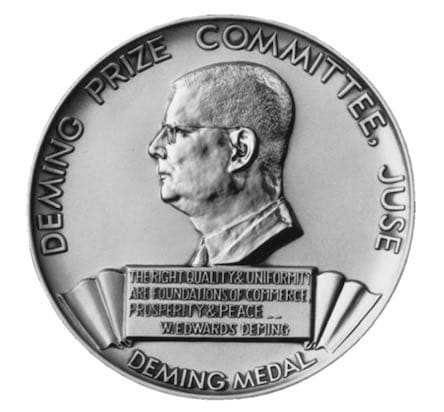
The inscription near the bottom of the medal1 is a quotation from Dr Deming:
“The right quality and uniformity are foundations of commerce, prosperity and peace.”
NB Throughout this course, exact quotations from Dr Deming are printed in blue in order to set them apart from my own writing. His own quotations are especially valuable in that he had the rare ability of being able to say a very great deal in remarkably few words. I wouldn’t want to mislead you into thinking that I am capable of the same degree of either brevity or wisdom!
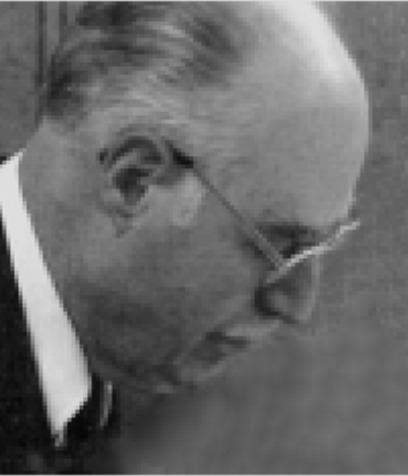
Almost five more years passed before Bill Conway discovered that this “Deming” was in fact an American, Dr W Edwards Deming who, although already in his late 70s, was still actively teaching and consulting, mostly in what he described as “statistical studies”.
Bill contacted Dr Deming and had several discussions with him—discussions concerning events ranging over the previous 30 and more years, the content of which Bill found extraordinary and initially almost unbelievable. Eventually, Bill persuaded Dr Deming to become a consultant for Nashua—although I suggest a “teacher” would have been a better description.
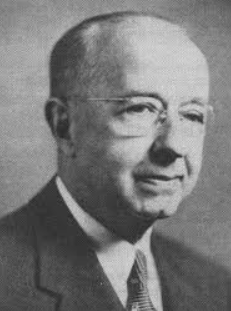
One of Dr Deming’s first recommendations was that Nashua acquire the services of an experienced statistician. On Deming’s advice, Bill “head-hunted” Dr Lloyd S Nelson, who at that time had been working in the General Electric Company for almost 30 years. That choice was particularly fortuitous for me because, although we had never met, I had been in correspondence with Lloyd for several years, particularly in connection with the Journal of Quality Technology which he had founded in 1970. A short while after moving to Nashua, Lloyd contacted me to ask if I would be interested in getting involved with Nashua’s British subsidiaries. I accepted the invitation.
My main initial task was to help set up and supervise a company-wide training scheme, mostly on some of what are often referred to as the “old tools” or “seven tools” of quality. Lloyd’s syllabus included the Ishikawa diagram (“fishbone” chart), the Pareto chart, flowcharting, brainstorming, and an all-important statistical tool invented by Dr Walter A Shewhart in 1924: the control chart. Don’t worry if you haven’t heard of some or all of these since the control chart is the only such “tool” to be studied in any detail and used in this course. And, even there, anything beyond the basics will just be “optional extras” for those who are really interested in them. Later today we shall also see an extremely important illustration which Deming referred to as a “flow diagram”, but that’s not quite the same as what most people mean by “flowcharting”.
The four-day seminars
I had no communication with Dr Deming himself during that time. I did, of course, hear more and more about him. One of the things I heard was that the people at Nashua Corporation had encouraged him to prepare and present a public seminar on his work. That seemed reasonable enough to me, but what astonished me was the length of the seminar: four days. Four days? In the university at which I was then teaching Mathematical Statistics, I was more used to seminars lasting an hour at most—and often that seemed too long! But the four-day seminars were clearly successful, and were soon being presented at least once a month. Audiences, which naturally had initially been quite small, were soon being counted in several hundreds at a time.
Then in 1982 a friend at Nashua here in the UK gave me a copy of the mimeographed book which Dr Deming was now issuing to all the delegates at his seminars. It was called Quality, Productivity, and Competitive Position—the same title that was often used at that time for his seminars. It was through this book that I began to discover Dr Deming’s work involved far more than just Statistics!
My first direct contact with Dr Deming came in 1985, and in a wholly unexpected and very privileged fashion. In the Spring of that year, out of the blue I received a letter from a senior official of the George Washington University which, at that time, was administering the four-day seminars. The letter said that Dr Deming was coming to London that summer to present his four-day seminar in Britain for the first time, and had requested that I be invited to assist him at that seminar.
The London four-day seminars became an annual event from 1985 to 1991 inclusive, and I had the same privilege of working with Dr Deming as his assistant at all of those seminars. I was also involved with him in many other events, both in this country and elsewhere, for the rest of his life. The last time I was with him was at his final four-day seminar in Europe, held in Zurich in July 1993, just five months before he died.
I’ll briefly describe the style of the four-day seminars for you. Basically, except for the breaks, Dr Deming spoke from 9.00 to 4.00 each day (except for finishing a little earlier on the final day so that the delegates could get back home). Then the delegates would split into Working Groups to deliberate, often long into the evening, on a choice from a large selection of topics and questions that Dr Deming had compiled. This is where assistants like myself would be busy helping the Working Groups, and then later designing and organising a programme of feedback from the Groups to be presented the following morning for the hour before Dr Deming resumed his teaching. However, he was always there: watching, listening, learning.
The British Deming Association and later
Not surprisingly, I soon began to present my own seminars on Dr Deming’s work and, largely with the help of people that I met at those early seminars and at the London four-day seminars, encouraged the formation of the British Deming Association in 1987. The BDA was a not-for-profit educational organisation having the aims of spreading awareness and aiding understanding of the Deming management philosophy.
Regrettably, “not-for-profit” eventually became too accurate a description, and the BDA is no longer with us. However, over several years, it was effective at “getting the ball rolling” as regards stimulating interest in Dr Deming’s work both in the UK and elsewhere and providing facilities for genuine learning about it. I am glad to say that much of the BDA’s range of activities and learning has subsequently continued through various groups and internet links, some of which I’ll briefly introduce to you in what follows.
Firstly, there are a number of references in this course to events that were organised by the BDA and to the substantial series of BDA Booklets that were written by groups and individuals in, or connected with, the Association. Those booklets, now renamed the “Deming A5 Booklets”, are obtainable from the Learning Store at the Deming Transformation Forum in the UK (www.deming.org.uk; site no longer online, 2012 archived snapshot linked) which also supplies a range of other Deming-related materials including relevant books and DVDs. The Forum can be contacted for specific advice and assistance including mentoring for individuals and bespoke in-house seminars.
I know of the following long-established and active Deming-based groups in the UK, although there may possibly be more. One is the Deming Alliance which began its days as a group within the BDA. The Alliance’s website is https://www.demingalliance.org and their meetings are held in the Midlands. The Chartered Quality Institute has a Deming Special Interest Group which usually (but not always) meets in London. You can reach it by selecting “Community” at https://www.quality.org and then “Special Interest Groups (SIGs)”. Also, the Deming Learning Network (DLN) is based in Scotland with meetings mostly held in Aberdeen. To contact the DLN you are welcome to e-mail Tony Miller at tony@jmiller.co.uk who can add you to his e-mail list for announcements of meetings and for guidance on becoming involved in online participation. I am sure that all three of the above will welcome contact with 12 Days students—so there’s no need to be shy!
Worldwide, the W Edwards Deming Institute (WEDI) in America is the obvious initial source. The Institute was founded by Dr Deming just before his death in 1993 and becomes more and more active as the years go by. Their main website is http://www.deming.org and there you will find extensive resources on Dr Deming’s work and teaching, including many of his publications at https://deming.org/deming/deming-articles. The Institute presents various seminars and offers videos including the Deming Library (see today’s page 13) and some substantial extracts from his celebrated four-day seminars. The Institute also has a YouTube channel which includes the 1980 NBC White Paper If Japan Can, Why Can’t We? (see page 37) that was so successful in introducing Dr Deming to the American public in 1980.
Also in America, SPC Press Inc (https://www.spcpress.com), who published my book The Deming Dimension in 1990 (see pages 12–13 in the Welcome section of file A. PLEASE START HERE), is another excellent source for Deming-related publications, materials and seminars. It is also one of the websites that are hosting the complete 12 Days to Deming material.
Finally, during the second half of 12 Days to Deming, you will be reading some excellent material by my good friend Balaji Reddie, founder of the Deming Forum of India in 1999. His website http://www.deming.org.in is also a host website of the complete 12 Days to Deming material.
Further, some time spent searching the internet is likely to lead you to any number of other relevant blogs, LinkedIn contacts, podcasts, FaceBook material, etc, etc. Happy browsing!
Copyright© Deming Prize Committee. All Rights Reserved. https://www.juse.or.jp/deming_en/↩︎