SECTION 2: WISDOM FROM PETER SCHOLTES
~ 7 min reading
Section 2: WISDOM FROM PETER SCHOLTES
The fourth section of today’s material will focus on Dr Deming’s own guidance about leadership. As you know, for a whole book on leadership full of practical guidance and solidly aligned with the Deming philosophy, my clear recommendation is Peter Scholtes’s The Leader’s Handbook (which, unlike Bill Scherkenbach’s book just mentioned, is still at undergraduate level!). It is therefore appropriate to include at this stage some of Peter’s own ways of helping us to understand the System of Profound Knowledge.
Profound Knowledge in a motor equipment operation
First, here is Peter’s story that I mentioned on page 1, in the Overture. As I said there, this all happened long before Dr Deming had begun to speak of the System of Profound Knowledge. But again, what an excellent demonstration of its wisdom and effectiveness this account turns out to have been! You may also find Peter’s narrative to be helpful in Activity 12–b on page 9.
“One of my first experiences in applying Deming’s philosophy was with the City of Madison, Wisconsin Motor Equipment Operation. Motor Equipment was responsible for maintaining and repairing city vehicles, ranging from police cars to garbage trucks, snow ploughs, and Zambonis [the latter are machines for resurfacing the ice in ice rinks]. I had developed some expertise in the areas of organisation development and teamwork. I worked with the late Dr Bill Hunter, a statistician from the University of Wisconsin, who was also very knowledgeable about Deming’s philosophy.
In the first meeting with the people from the First Street Garage, where Motor Equipment was located, we asked them: ‘What are your biggest problems?’. ‘Morale!’ was their immediate and universal response. I didn’t want to work on morale problems because they are symptoms of something else, so working on them usually involves a lot of useless complaining. I got them to agree to defer working on the morale problem.
They started to work on two other projects: customers’ feedback and cycle time. The immediate customers of the Motor Equipment Operation were the other municipal agencies that needed their vehicles to be up and running: the Police Department, Parks Department, Streets Department, etc. The Motor Equipment people did surveys and interviews of their customers to learn their perceptions regarding the services of Motor Equipment. They identified the chief customer complaints and the customers’ priorities (which types of jobs should take priority over others). Much to their delight, the Motor Equipment people also learned that, for the most part, the customers were pleased with their service.
The cycle time project studied how long it took from the time a vehicle broke down until it was back in service. They identified all the stages of the downtime process and how much time each consumed. Then they spun off some subprojects aimed at reducing the cycle time. For example, one effort was aimed at reducing the time spent waiting for parts. After six or eight weeks of involvement in such activities, I suggested at a meeting: ‘Now let’s talk about the morale problem’. ‘What morale problem?’ they responded.
The originally-presented problem, morale, was part of the psychology area of the System of Profound Knowledge [Part D in Dr Deming’s ordering]. I suggested, instead, activities focused on understanding the system, beginning with the customers, who are the end point and purpose of the system (a second area of Profound Knowledge [Dr Deming’s Part A]). The study of the system and cycle times inevitably involved studying variation in the components of cycle time: which delays were due to unique (special) causes and which were built into the current system (common cause). This is, of course, a third area of Profound Knowledge [Dr Deming’s Part B]. Knowledge of the system and variation allowed them to focus on improvements dealing with the systemic causes of problems. Because of their expanded knowledge of customers, systems, and the methods of improvement, the Motor Equipment people made dramatic improvement on problems that had plagued the operation for decades. (Learning, knowledge, and improvement are the fourth area of Profound Knowledge [Dr Deming’s Part C].) All of this led to excitement, pride, great motivation, and an evaporation of the morale problem.”
Introduction to Activity 12–b
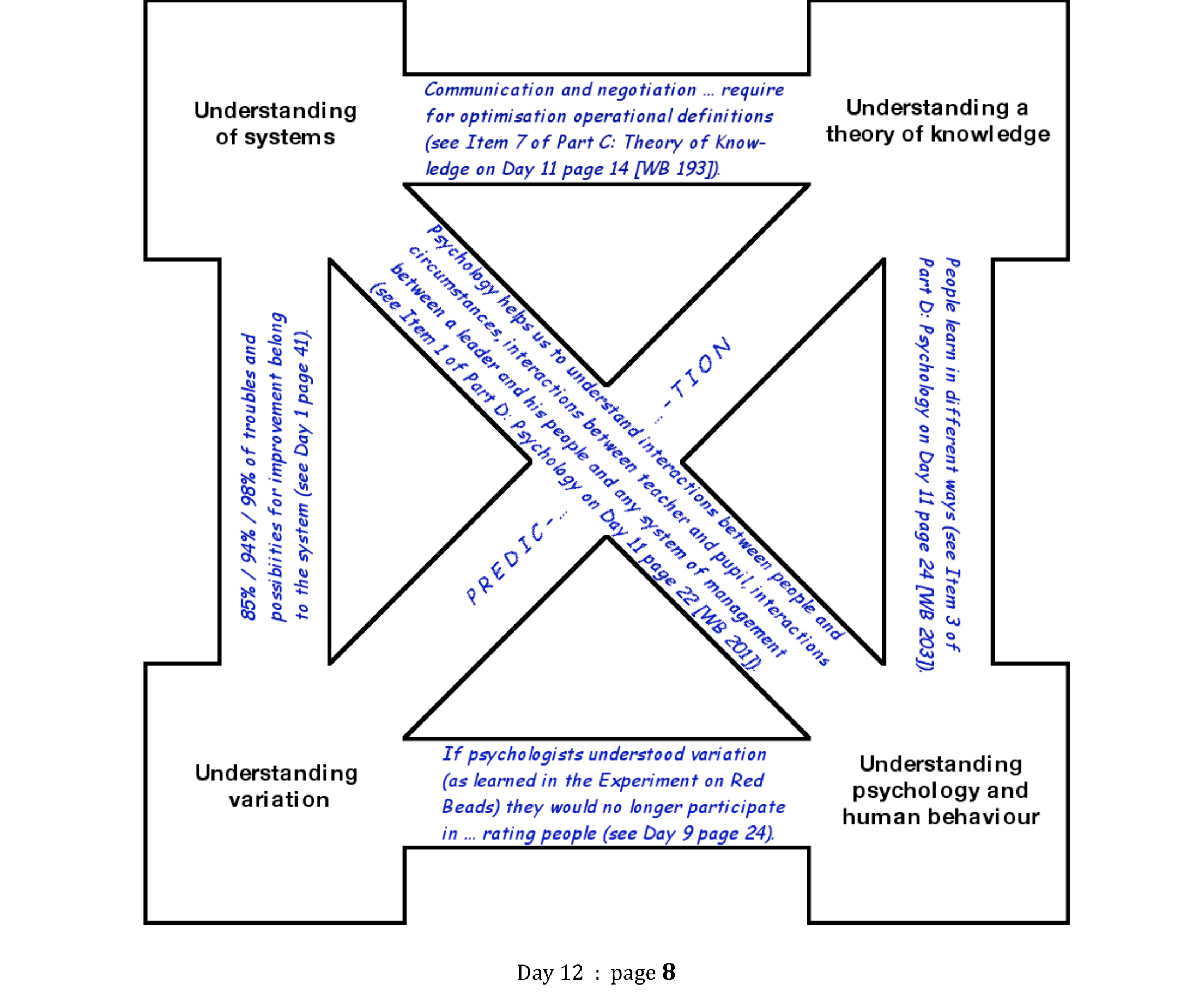
As mentioned when we first saw it on Day 1, Peter’s diagram of the System of Profound Knowledge immediately depicts the interlinking nature of the four parts of the System. But there were no words on the interlinks! So, as yet a further contribution to your appreciating the Deming philosophy as a system, Activity 12–b asks you to try to identify some important connections between the four parts. You’ve now seen major issues in each of the four parts identified (a) in Peter’s story just related, (b) in the expanded version of his diagram of the System of Profound Knowledge on Day 9 page 22, (c) on Balaji Reddie’s “Contributions” page 34 and, of course, (d) throughout the Second Project on Days 10 and 11. Think through some of this material and see if you can recognise how any of those major issues can link into any of the other three parts in addition to the part in which it has first been raised.
To get you started, here is just a single thought for each of the six links:
Describe this diagram
The same Scholtes 2×2 System of Profound Knowledge frame from Day 9 (Understanding of systems top-left, Understanding a theory of knowledge top-right, Understanding variation bottom-left, Understanding psychology and human behaviour bottom-right) — but now the connecting shapes between the four boxes (and the central “PREDICTION” diamond) carry sample sentences, in handwritten-style blue, that link one part to another. Examples Neave provides: “Communication and negotiation … require for optimisation operational definitions” linking systems to theory of knowledge; “If psychologists understood variation … they would no longer participate in … rating people” linking variation to psychology; “People learn in different ways” linking theory of knowledge to psychology. The point of the diagram is the interlinks, not the four parts themselves — the parts are already familiar; the work of Activity 12–b is to fill in your own interlinks.
Recall that, at the end of Day 11, I suggested you make some copies or, preferably, enlargements of this page. Now you may soon see why!
A System of Profound Trouble!
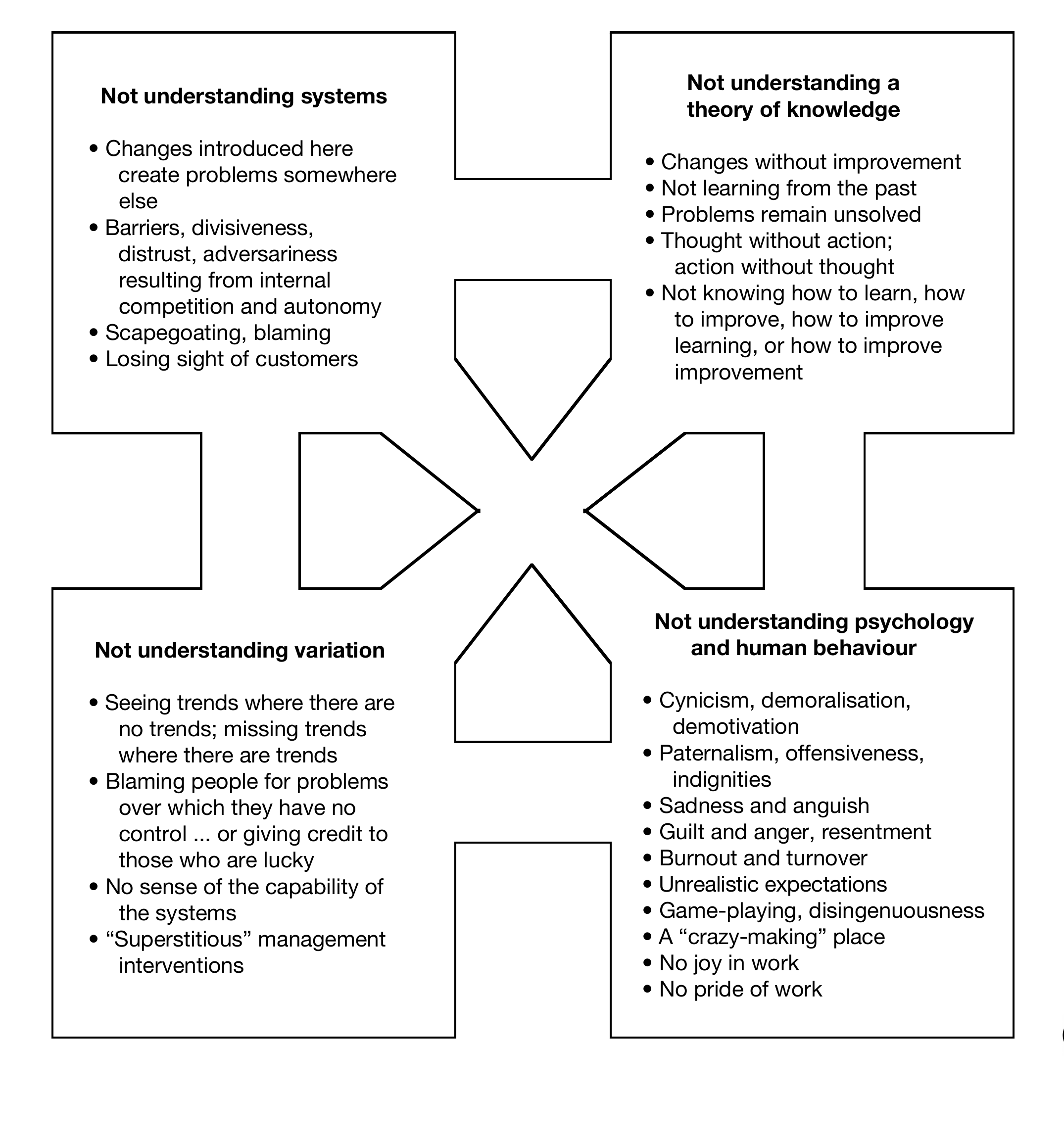
Finally in this section of Wisdom from Peter Scholtes is his delightful—and instructive—representation of “A System of Profound Trouble”! I need add nothing in explanation.
Describe this diagram
Peter Scholtes’s parody of his own System of Profound Knowledge diagram — same 2×2 layout meeting at the centre, but every label is now negated. Top-left “Not understanding systems”: changes here create problems somewhere else; barriers and divisiveness from internal competition; scapegoating and blaming; losing sight of customers. Top-right “Not understanding a theory of knowledge”: changes without improvement; not learning from the past; problems remain unsolved; thought without action and action without thought; not knowing how to learn. Bottom-left “Not understanding variation”: seeing trends where there are none and missing the real ones; blaming people for what they cannot control; no sense of system capability; “superstitious” management interventions. Bottom-right “Not understanding psychology and human behaviour”: cynicism, demoralisation; paternalism, indignities; sadness, anguish, resentment; burnout; “a ‘crazy-making’ place”; no joy in work, no pride of work. The diagram is funny only until you read it twice — every entry is a recognisable everyday symptom of management without Profound Knowledge.
ACTIVITY 12–b
Following some of the guidance on page 8—and anything else that comes into your mind—now try to identify a few of the important connections between pairs of the four parts of the System of Profound Knowledge and write them in on Peter Scholtes’s diagram below.