AT THE FORD MOTOR COMPANY
~ 3 min reading + activities
On page 2, in the Back to the Western Electric Company section Dr Deming claimed that, if we mix up the two types of variation, “we only make things worse. This is easy to prove.” So let’s prove it! Here is a well-known illustration, originating in the Ford Motor Company (see Bill Scherkenbach’s The Deming Route to Quality and Productivity, around page 30 depending on the edition and reprint numbera).
Input shafts for a transmission were turned in a machine equipped with an expensive automatic compensation device. If the diameter of a shaft was too large, the compensation device reduced the machine setting in order to try to make the next diameter closer to its nominal value. If the diameter was too small, the setting was increased, for the same purpose. Sounds sensible?
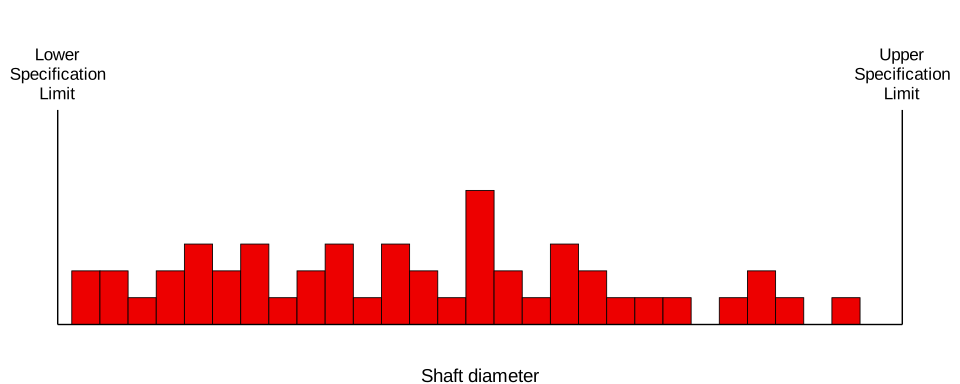
Here is a histogram of the diameters of 50 shafts consecutively manufactured by this process. (A “histogram” is a widely-used type of diagram for illustrating data. But in case you’re not sure about what a histogram is, I’ll guide you on how to draw one on page 7, in the section below.)
Describe this chart
A histogram of 50 shaft diameters made with the automatic compensation device switched on. The distribution is broad and reaches outside the specification limits at both ends. (Look carefully — the chart shows only 49 boxes; one shaft, presumably an out-of-spec one, appears to have quietly disappeared.)
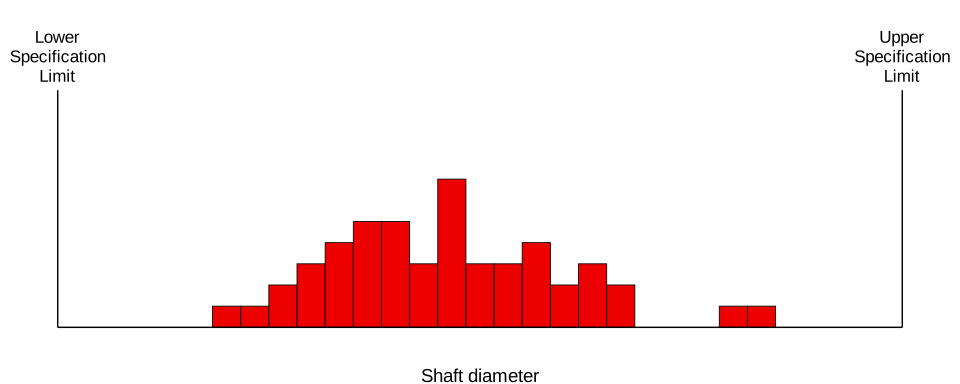
A statistician recommended that the next 50 shafts should be made with the compensation device turned off. Here is the histogram of those 50 diameters.
Describe this chart
A histogram of 50 shaft diameters made with the compensation device switched off. The distribution is visibly narrower than the one above — all 50 values sit comfortably inside the specification limits. The lesson: the “sensible” feedback device, which adjusted the machine setting after every shaft, was adding variation rather than reducing it. Reacting to common-cause variation as if it were a special cause makes the process worse.
Reduced variation! Better quality! Everything clearly within the specifications! With that sensible and very expensive compensation device turned off!
ACTIVITY 3–c
To repeat:
“Reduced variation! Better quality! Everything clearly within the specifications! With that sensible and very expensive compensation device turned off!”
How could this be?
(If you cannot answer this question now, be sure that you will be able to do so before you finish working through today’s Major Activity!)