POSTSCRIPT
~ 5 min reading · ~ 30 min at Neave’s pace
I didn’t complete the story about Spaniards’ performances in the Experiment on Red Beads. So I should end today by remedying that deficiency.
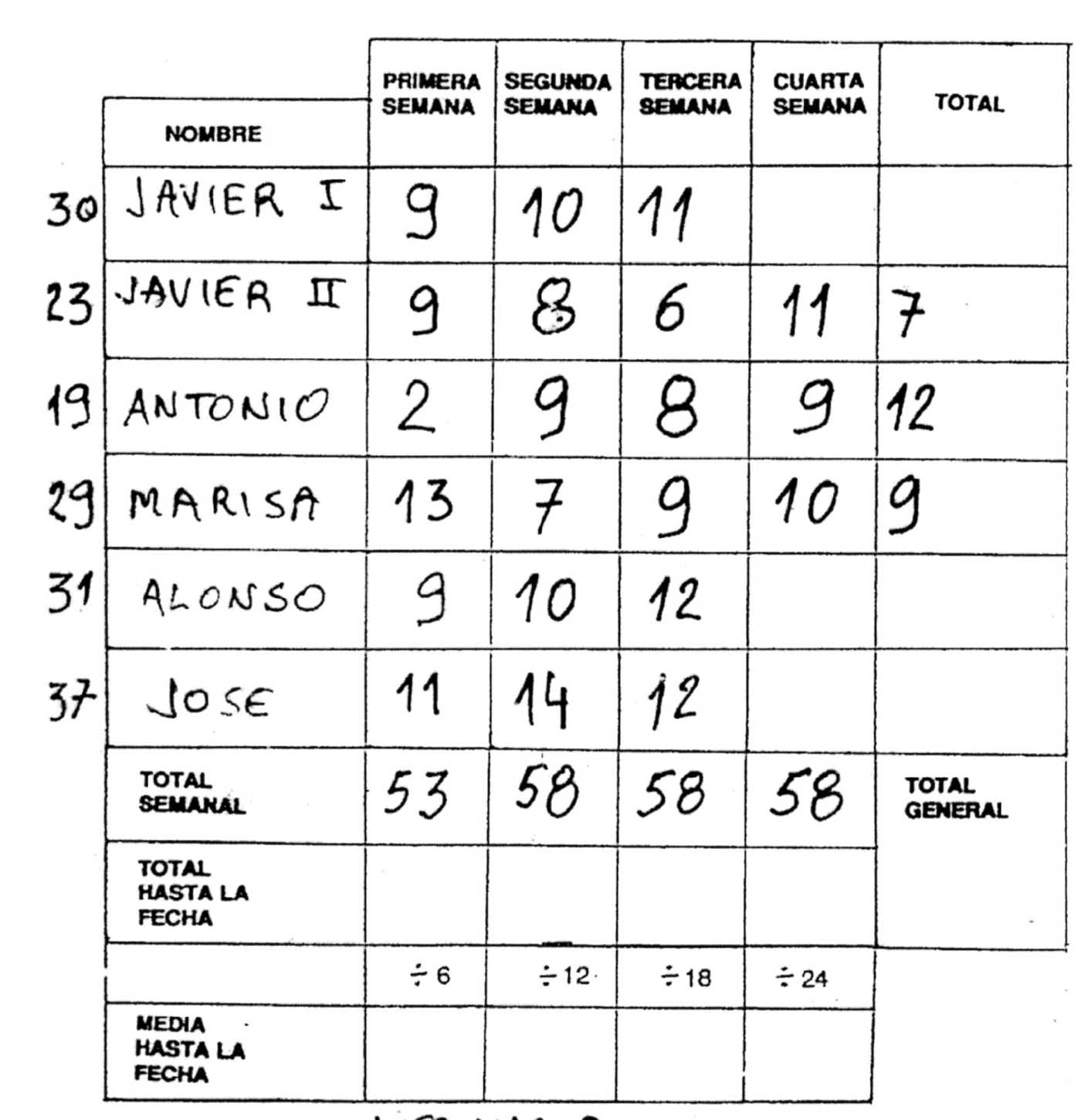
As indicated on page 28, at the start of Some Recollections, I presented two seminars in Madrid. On his return to that city, the Foreman could not resist telling the Willing Workers (and the audience) about the awful results obtained on his previous visit. Although the story met with mixed reactions, he was sure that the information would prove to be highly motivational for the new team—they would strive to do better in order to restore national pride. Their results as listed by Jorge were as follows:
Describe this table
The Recorder Jorge’s table from the second Madrid seminar. The six Willing Workers are listed down the side with their three-week totals: Javier I (30), Javier II (23), Antonio (19), Marisa (29), Alonso (31) and Jose (37). Weeks 1 to 3: Javier I 9, 10, 11; Javier II 9, 8, 6; Antonio 2, 9, 8; Marisa 13, 7, 9; Alonso 9, 10, 12; Jose 11, 14, 12. In Week 4 the three workers kept on work two shifts: Javier II 11 and 7, Antonio 9 and 12, Marisa 10 and 9. The weekly totals are 53, 58, 58 and 58; the rows for totals and averages so far are left blank.
These results are certainly rather different from those on my first visit to Madrid. The overall total of red beads (though not stated here by Jorge) was 227—not only much better than in November 1989 but notably better than the average over all my experiments using the same equipment. Further, no doubt as a result of the Foreman’s motivational introduction, the first week’s performance was pretty good, despite the relatively poor results from Marisa (clearly a slow learner) and Jose (who never quite understood what he was doing). The first week’s commendable total was largely due to the brilliant effort of Antonio who had been particularly incensed by the possible slur about Spanish workmanship that he had perceived in the Foreman’s introduction.
So, already by the end of the first week, the pressure was off. No way was this team of Willing Workers going to do anywhere near as badly as the previous Spanish contingent. And so they settled down to producing the rather less exceptional but very consistent overall performance that you see represented in the remaining weeks’ totals.
It was, of course, a pity that Antonio did not continue to work anywhere near as hard or as conscientiously as he had in the first week—but he had made his point.
Overall, the Foreman was, of course, immensely satisfied by the way he had motivated, indeed inspired, this workforce to perform so much better than their predecessors.
Of course.
“Wrap-Up Brief” following the Red Beads Experiment
My friend Dave Kerr has presented the Red Beads Experiment numerous times. He has developed a short document which not only summarises some of the learning which comes from it but also looks ahead to several important topics that we shall study later in this course, particularly on Days 8–11. I believe therefore that you might find it interesting to take a look at his “Wrap-Up Brief” now while the experiment is fresh in mind to see some tasters of issues that may not have occurred to you so far. Further, it could also be valuable for you to look back at Dave’s summary a number of times during the second half of the course to see how this “stupid experiment” relates to the topics developed there.
I am delighted to be able to reproduce Dave’s document on Appendix pages 12–13.
“Out-of-hours” note
As mentioned on page 11 of the introductory Welcome section, you will need to carry out some preparation for your Major Activity on Day 3. It was noted there that this and all such “out-of-hours” tasks are briefly summarised on Appendix page 1. Also, to aid your study on the morning of Day 3, you will find a recommendation in that summary to print in advance a separate copy of Day 3 page 19.
Day 3’s Major Activity is a complete version of the Funnel Experiment although it uses different equipment from Dr Nelson’s original version. The original version would need much more preparation than the version which will be used tomorrow and you would also find that version much more awkward to perform. I recommend that you carry out in advance the necessary preparation rather than leaving it until tomorrow: you will find all the information you need on Day 3 page 36. Either start reading near the top of that page or, for a more comprehensive introduction, go back to the beginning of that section on Day 3 page 35.
To carry out Day 3’s experiment does not actually need any “previous knowledge”: previous knowledge is only involved with interpreting the results from the experiment. The experiment itself can be carried out by anyone. But people who, for example, like solving puzzles and/or playing board games will probably take to it better than those who don’t. So if you are not an enthusiast for puzzles and board games then why not invite a friend who does enjoy such activities to join you tomorrow afternoon?—it could be more enjoyable for you to have such company during the experiment. And don’t forget: you will need to find a couple of standard dice in order for you to play this “silly game”!