“OUT-OF-HOURS” PREPARATION
~ 13 min reading
“OUT-OF-HOURS” PREPARATION FOR THE SECOND PROJECT
As you know, I have not been asking you to do any significant amount of work between the individual days of this course. But now, as we approach the Second Project, some prior preparation becomes highly advisable. The Second Project is the climax of your learning about Dr Deming’s theory of management in this course: it is a both substantial and vitally important piece of work. So here I’ll give you some guidance on what I believe you will find fruitful to do “out-of-hours” before you begin Day 10 and then, to a shorter extent, before Day 11. The amount of time advisable to spend on this preparation is, say, an evening between Days 9 and 10 and another hour or so before Day 11. I think you will find the type of preparation I suggest here will then pay considerable dividends as you work through the project.
My recommendations here will be in three sections, and I suggest you think of spending an hour or so on each of these sections during your preparation before Day 10. However, the preparation you do on two of the three sections will be adequate for both Days 10 and 11, and so you will only need to work with the one remaining section in your preparation prior to Day 11.
First, you have seen that the final step in the four-step procedure described on pages 19–21, starting where the four steps are described is for you to think about the links between each part of the System of Profound Knowledge and our old friends from Days 4 and 5: adopting the 14 Points and curing the Deadly Diseases. This coalescence of Dr Deming’s main emphases in the 1980s with those in the 1990s is, of course, a continuation of our gluing together lots of components of his teaching into a solid, secure whole for which I have often used the analogy of fitting pieces into a jigsaw. (I am, of course, not forgetting about understanding variation, but that emphasis was always there.) However, as you haven’t seen anything of the 14 Points and Deadly Diseases since Day 6, it would be good to refresh your memory about them during your preparation for this Second Project.
Second, you have now seen three short introductions to the System of Profound Knowledge: Peter Scholtes’s diagram, the introduction in DemDim Chapter 18, and Dr Deming’s own brief introduction to his May 1990 version. Following this current section here I shall ask you to read through Balaji Reddie’s excellent material that I introduced to you on page 23, where Balaji Reddie’s material is introduced. For your out-of-hours preparation I shall mainly guide you to spend some more time with Balaji’s writing in conjunction with DemDim Chapter 18 while also keeping an eye on Peter Scholtes’s diagram. This more substantial introductory learning about the System of Profound Knowledge will give you a good grounding in readiness for the project.
Finally, and particularly important, you will need to thoroughly familiarise yourself in advance with, as it were, the mechanics of the Second Project, i.e. what you will be doing at each stage of the four-step procedure. You’ll recall that, rather than my laying down the law about precisely how you should carry out those four steps, I am suggesting various options to you from which to choose. Obviously, it would be sensible for you to consider these options beforehand and figure out what choices most appeal to you rather than spending lots of time trying to decide on them once the project is under way.
So let’s take these three sections of your preparation in turn. Incidentally, it will aid your progress with the Second Project if you are able to make a few photocopies prior to Day 10 in order to avoid too much flipping backwards and forwards in the course material during the project. I’ll summarise details on page 30, the out-of-hours note.
First, for your refresher on the 14 Points and Deadly Diseases, you could of course return to the main reading referenced on Day 4, namely DemDim pages 39–52. There is also the whole of Part 5 of DemDim and, if you have it, Out of the Crisis pages 17–107[18–126]. But, obviously, either of those would need some remarkably fast reading if you were working on my suggested timeframe!
Instead, I think it would be very useful for you to simply revisit your work on the First Project (Days 4 and 5). Not only will this automatically remind you of what the 14 Points and Deadly Diseases actually are, but it will also remind you of how you linked them there to the three bases of the Joiner Triangle. Why this will be particularly useful is that similar kinds of thought processes to those that you used there will also be appropriate for the Second Project. The reason will be immediately clear if you refer back to my small-print paragraph on today’s page 21, the small-print paragraph on the Joiner Triangle connections: i.e. there are some clear relationships between the Joiner Triangle’s three bases and the four parts of the System of Profound Knowledge.
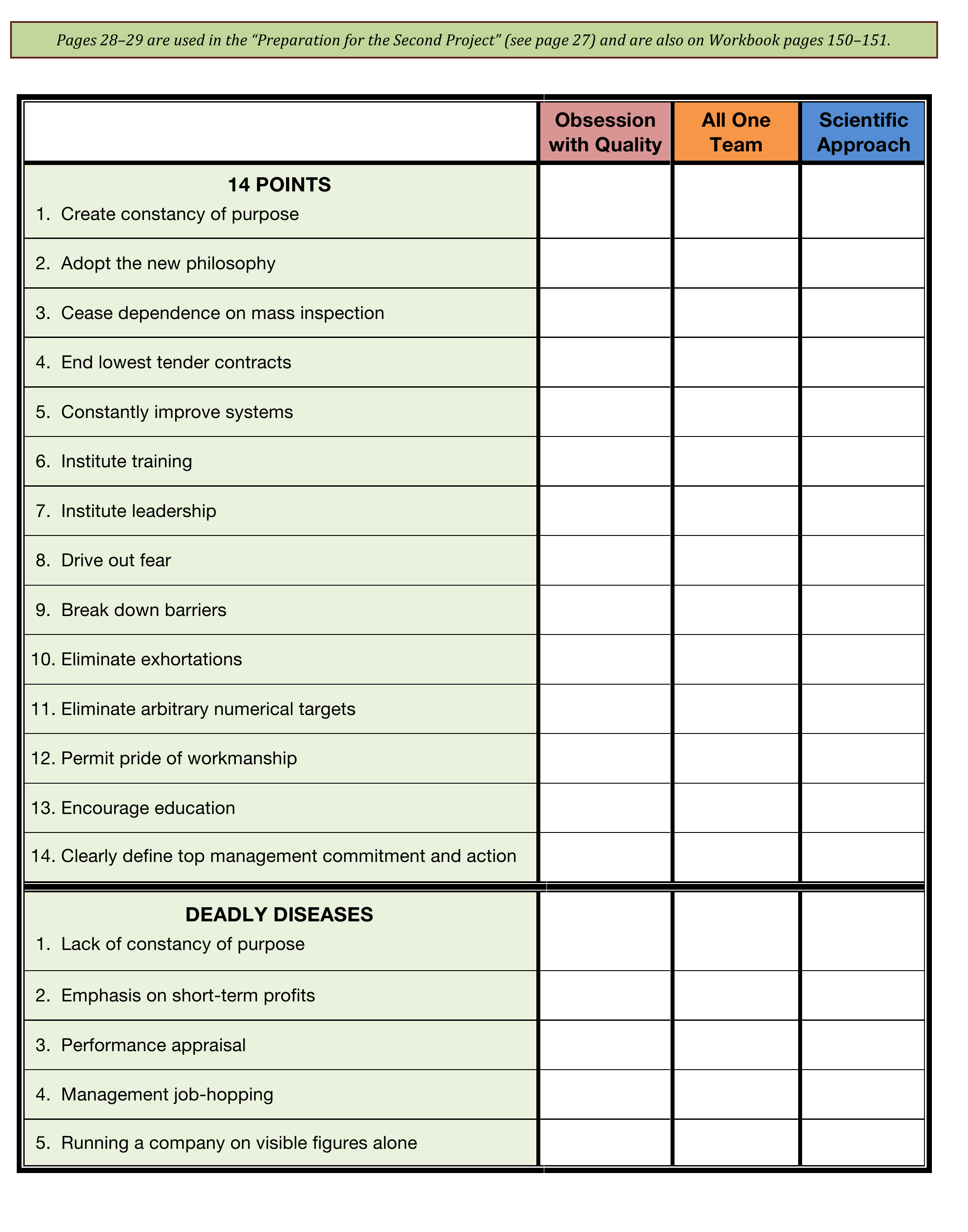
While reading through my descriptions and your work in the First Project, you will find it very helpful to use the table on page 28, the 14 Points/Diseases table on which to summarise the strengths of the links that you saw on Days 4 and 5 between the bases in the Joiner Triangle and adopting the Points and curing the Diseases. Then, when thinking of referring back to your work there while carrying out the Second Project, your entries in this table will give you some good clues as to when and where it will be worth your while to look back. I suggest you use the same kind of 0–5 scale in this table as you used during Day 6 (ranging from 5 = very strong relationship to 0 = no apparent relationship).
For the second section of your preparation (your general grounding in the System of Profound Knowledge before tackling the detail during the project) I suggest the following. First, it would be a good idea to always have a copy of Peter Scholtes’s diagram from page 22 in front of you to remind you of a few of the main features and nature of the content of the System of Profound Knowledge. Next, remember that this afternoon you will soon be reading through Balaji’s Four Preludes, relating respectively to the four parts of the System of Profound Knowledge. I also recommend that, at the end of this afternoon, you should read through the rest of DemDim Chapter 18 (pages 264–280) in order to get a more comprehensive idea of what Balaji’s Preludes are introducing you to!
Day 10 is only concerned with Parts A and B of the System of Profound Knowledge, so you can concentrate just on those two parts in your preparation before Day 10. Then, of course, your preparation for Day 11 will concentrate on Parts C and D. I suggest the following for each of the four parts. First, re-read Balaji’s corresponding Prelude. Then go carefully through the few (between three and six) relevant pages in DemDim, jotting down some notes to record where you see the links between Balaji’s material and the DemDim material. These notes will then be able to guide you about the links when you get into the Second Project itself.
Finally we come to the reminders about the four-step procedure to be used for each of the four parts. The procedure will be identical for each of Parts A, B and D except that the time allocated will differ according to the amount of work there is to do. The procedure will be modified for Part C because of its different structure, but I’ll leave the details until Day 11.
As suggested a little earlier, in order to avoid wasting precious time during the project, it will be wise for you to (a) familiarise yourself with the four-step procedure during your preparation session and also to (b) consider if there are any of the range of choices I have suggested which either particularly appeal to you or, on the other hand, you feel you are not really interested in doing. So I recommend the following:
First, carefully re-read my descriptions of the four steps, starting on page 19. There you’ll need a copy of page 29, the one-page summary of the whole four-step procedure: this focuses on the various choices I have already suggested to you along with one or two more. Think about these and then highlight any that particularly appeal to you and strike out those that you wish to reject. You could, of course, add further choices of your own. And then, throughout the Second Project, refer to your annotated version of page 29 to guide you through the procedure each time.
To conclude Day 9, however, please now move over to page 30 to think about which parts of the material you might like to duplicate to avoid having to keep frequently skipping around during the project!
Summary of the four-step procedure
Step 1: Browsing session
Suggestions:
- Read the relevant part of Balaji’s “Contributions” (around six pages);
- Read the relevant part of DemDim chapter 18 (average of four pages);
- Browse through the material for the half-day up to, but not including, the Activity.
The purpose of this browsing session is similar to a gymnast’s “limbering-up” session before getting onto the strenuous exercise. The difference is of course that, rather than limbering up your muscles, you’ll be limbering up your brain!
Step 2 [analogous to the gymnast’s “strenuous exercise”!]: Dr Deming’s May 1990 version
Choices for your work on each item (remember: “choices”—not to attempt them all!)
- Immediate reactions upon reading it (e.g. “Really important”, “I’m already familiar with this”, “My organisation is doing the direct opposite to this”, “Why is he saying this?”, “What does he mean by that?”, “What does this imply?”, “Why is my organisation doing the direct opposite to this?”, “What would be the benefits if my organisation stopped doing the direct opposite to this?”.
- Try to answer one or more of those questions.
- Note down any illustrations from your own experience relevant to this item.
- If your initial reaction was something like “I’m already familiar with this”, try writing a brief explanation of the item to your friend who is not yet familiar with Dr Deming’s work.
- Further, with Step 4 in mind, I’ll include an additional suggestion: immediately note down any links to any of the 14 Points or curing the Deadly Diseases that occur to you.
Step 3: DemDim version
Read the relevant part of DemDim Chapter 18 (irrespectively of whether or not you browsed through it in Step 1) and, while doing so,
- see if you need to update some of your earlier comments;
- see if you can answer any of your earlier questions;
- comment on matters included here which were not in the May 1990 version, and again make a note of any further links with the 14 Points and/or the Deadly Diseases.
Step 4: Activity (connections with the Points/Diseases)
First, use your notes made with respect to the final bullet-points in both Steps 2 and 3 above to jot down relevant comments against some of the Points and/or Diseases. Next, with the aid of your table on page 28, add further comments prompted by your considerations during the First Project. Lastly, read through Dr Deming’s words in Step 2 one more time and then trace through the 14 Points and Deadly Diseases in turn, seeing if any further inspiration strikes you! Finally, and fairly speedily, allocate your scores on the 0–5 scale indicating what you now perceive as the strengths of the links with the current part (A, B, C or D) of the System of Profound Knowledge.
“Out-of-hours” note
You should have arrived here after page 27, where the First Project revisit begins.
The most obvious pages from today’s material that are worth you reproducing separately for your convenience during the Second Project are:
- page 22 (Peter Scholtes’s diagram);
- page 28 (after you have used it to summarise your work when looking back to what you wrote during the First Project);
- page 29 (similarly including your annotations on that summary of the four-step procedure).
If it is convenient for you to carry out a relatively large amount of printing or copying, I would suggest Balaji’s Four Preludes (not necessarily the “Lessons from History” section as that is more relevant to Day 12). You could then have the relevant Prelude immediately accessible to you during both Steps 2 and 3 and could also insert notes on it for your reference as you work through the rest of the four-step procedure.
You’ve had a lot of hard thinking to do today. But now it’s time for you to read through Balaji’s “Four Preludes and a Coda” (file Q). So relax, put your feet up, and enjoy!
And lastly, read through the DemDim coverage of the System of Profound Knowledge: either pages 264–280 of Chapter 18 or the whole chapter for completeness. Again, as you’ve been working very hard today, this is just an initial browse-through to get an idea of what’s there, rather than any real study. Remember that (although not printed in blue!) most of what appears in Chapter 18 is in Dr Deming’s own words. There will therefore be some overlap with what you will be seeing on Days 10 and 11. You’ll have much more time to study these pages from DemDim (just one part at a time) during your out-of-hours preparation sessions before Days 10 and 11. But, even during this first quick look, I think you will find several points of contact with what Balaji has just introduced to you this afternoon.
When you begin your out-of-hours preparation work, start at page 26, the start of this out-of-hours preparation section and then follow the guidance as indicated.
Approvals, Acknowledgments and Information
a (page 3, Deming’s Queen Elizabeth Conference Centre presentation) Dr Deming’s presentation at the Queen Elizabeth Conference Centre in London in July 1990 is fully transcribed in the Deming A5 Booklet A10 (formally BDA Booklet A10): Deming Speaks to European Executives, available from the Deming Transformation Forum: www.deming.org.uk.
b (page 9, the Scherkenbach “boxes and lines” diagram) This diagram from Deming’s Road to Continual Improvement has been reproduced with the approval of Bill Scherkenbach and SPC Press Inc.
c (page 11, the May 1990 System of Profound Knowledge extract) The May 1990 version of Dr Deming’s System of Profound Knowledge which is used during Days 9–11 is fully transcribed in the Deming A5 Booklet A9 (formally BDA Booklet A9): A System of Profound Knowledge, available from the Deming Transformation Forum: www.deming.org.uk.