INTRODUCTIONS TO THE SYSTEM OF PROFOUND KNOWLEDGE
~ 13 min reading
Introductions to the System of Profound Knowledge
Yes, “Introductions” in the plural. In order to prepare you as best I can for the coming major project, there now follow not one, not two, not three, but four introductions for you! Their natures and content are all very different: yet, of course, they all complement each other. Here again, I am trying to provide for the fact that “people learn in different ways”.
It is worth pointing out to start with that, in addition to your being familiar with the 14 Points and the Deadly Diseases from the First Project, you are also already familiar with some of the content of the System of Profound Knowledge. That is quite deliberate: it has been my intention during the course to introduce you to both the content and the nature of the System of Profound Knowledge relatively gradually. From what I have seen, ambitious attempts to plunge into the whole System of Profound Knowledge early on rather than taking it in gentler stages do not work well with most people. I fear that that was also true when Dr Deming attempted it in some of his later four-day seminars. I believe that, for the large majority of people, it’s too big and too different for that; it takes time. The taste-buds and the palate—and maybe the stomach as well!—need to become acclimatised. By taking the approach that I have, you will now encounter a mixture of the familiar and less-familiar over these next two Days. That will enable you to both reinforce and deepen what you already know, and also have some time to consider the new material. You will still have plenty more to learn: again, the main text from now on will be mostly in Dr Deming’s own words—and, as you are already aware, that gentleman could pack a very great deal into a very few words. And that is definitely the case in the May 1990 version of the System of Profound Knowledge. You have been warned!
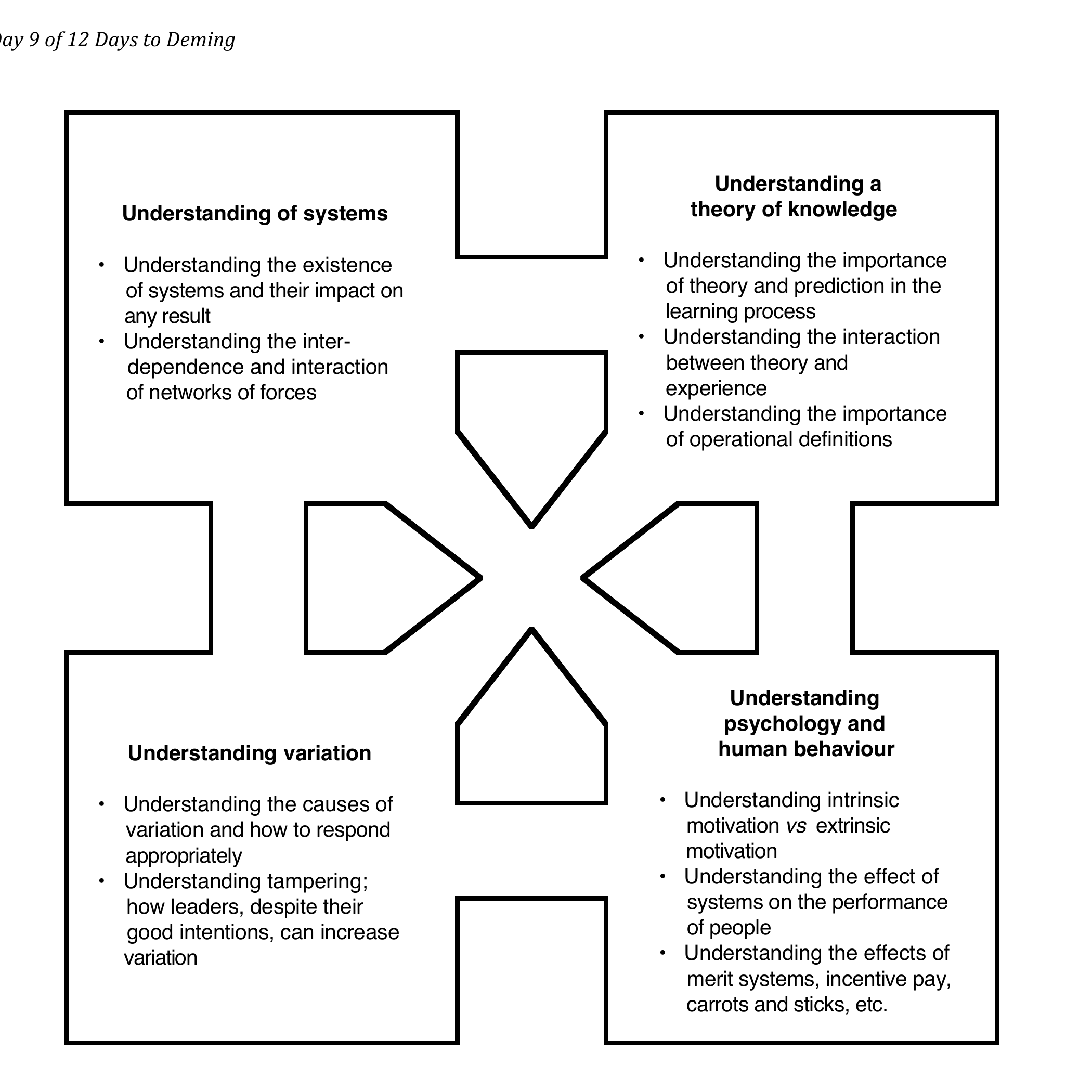
So, on to our four introductions to the System of Profound Knowledge. First, having recently reminded yourself of Peter Scholtes’s diagrammatic representation on Day 1, you will immediately recognise what follows—his own expansion of that diagram to include a few important aspects of each of the four parts:
Describe this diagram
Four large boxes arranged in a 2×2 grid, each pointing inward toward a small empty central box that holds the four parts together (the visual is reminiscent of jigsaw pieces meeting in the middle). The four boxes are: top-left “Understanding of systems” — the existence of systems and their impact on any result; the interdependence and interaction of networks of forces. Top-right “Understanding a theory of knowledge” — theory and prediction in the learning process; the interaction between theory and experience; operational definitions. Bottom-left “Understanding variation” — causes of variation and how to respond appropriately; tampering, and how leaders despite good intentions can increase variation. Bottom-right “Understanding psychology and human behaviour” — intrinsic vs extrinsic motivation; the effect of systems on people’s performance; the effects of merit systems, incentive pay, carrots and sticks. The diagram’s shape is the message: the four parts are not a list but a system that meets at the centre, each one shaping the others.
Particularly in your early days of learning about the System of Profound Knowledge, Peter’s diagram here is well worth repeated attention. Although there are only two or three entries in each part, they are enough to remind you of the type and flavour of the content of each of the four parts, rather beyond that which merely their titles might imply. Take a little time to look through them carefully, say, three or four times before continuing.
Advance notice: On Day 12, for still further learning and also amusement, we shall see Peter’s superb parody of the above diagram: “A System of Profound Trouble”!
Second, we have the short introduction to the System of Profound Knowledge in DemDim. Soon after you start reading it, you will recognise that it is not in my own normal style of writing! No, in fact almost all of the main text in Chapter 18 from this point onward is in Dr Deming’s own words, with my contributions appearing in small print. However, both in that introduction and with each of the four parts, I was quoting from a variety of his presentations and writings. Therefore there is generally rather more text in my Chapter 18 than there is in Dr Deming’s May 1990 version, including some material from his later versions. Nevertheless, his exceptional conciseness of style will still be well in evidence throughout the rest of Chapter 18. I suggest you now read this introduction (DemDim from the bottom of page 261 through to page 264) two or three times before continuing.
Third comes Dr Deming’s own introduction to the May 1990 version which you’ll find on pages 24–25, starting where Deming’s introduction begins. But, before embarking upon that, I will tell you about the fourth and final introduction. This is what I’ve already highly recommended to you on page 19, where Step 1 of the four-step procedure begins. It is of a totally different nature from the other three—it’s rather longer, but is easier to read!
Balaji S Reddie, based in Pune, India, began to become familiar with Dr Deming’s work around 1995. I was delighted to be able to encourage and tutor him (largely by telephone), and he proved to be a most willing and rewarding student. I was also pleased to be able to visit him in 2001 and to present seminars on his behalf in both Pune and Chennai.
A few years ago, Balaji wrote a series of 25 short newspaper articles to introduce readers to the System of Profound Knowledge—a rather ambitious task! By “short” I mean barely one page each in terms of the format and size of type being used in this course material. He largely achieved this through the inclusion of numerous short real-world illustrations to aid the readers’ understanding of the concepts that he introduced. When Balaji sent me these newspaper articles after they had been published, I was tremendously impressed by how much of the essence of each of the four parts he had been able to include in such a small space, and to do so in a manner that is both eminently readable and enjoyable. Of course, it is no “complete coverage”, but that is not needed in an introduction.
As I was developing the current section of the course, I realised that the content of his series of short articles could be extremely valuable to 12 Days students. Relatively “gentle” and light reading on the System of Profound Knowledge is hardly easy to come by! Balaji was kind enough to give me permission to use his material and to amend it into whatever form I thought most suitable for inclusion here. I have therefore taken the articles relevant to each part of the System of Profound Knowledge and moulded them into a continuous read, rather than retaining all the discontinuities of the original individual articles. I have also added a few references to other material in the course, so that Balaji’s writing really does now become an integral part of the whole. Similarly, I have now inserted into Days 10 and 11 a number of pointers to useful links with what Balaji has written, although without any attempt to mention them all.
There were around five of Balaji’s short articles relating to each of the four parts, plus a summing-up as the final article of the set. We have called the revised format “Four Preludes and a Coda” (continuing the musical analogies of the “Overture”!). A few of the articles toward the end of the series were more concerned with both good and bad efforts to put theory into practice, rather than with the theory itself, and so those will form the basis of a final contribution which is more appropriate as additional reading on Day 12.
There will be time for you to read through the whole of the “Four Preludes and a Coda” today. Also I am sure it will then be well worth your while to read it again sometime before you begin the Second Project on Day 10. Next, as I implied on page 19, where Step 1 of the four-step procedure begins, I strongly recommend that you include the relevant “Prelude” within the browsing session that begins your study of each of the four parts. Indeed, I suggest you start your browsing session with it in order to remind yourself of what’s there before doing anything else.
And finally we reach Dr Deming’s own introduction to his May 1990 version. Like the first two introductions, this is quite short and, as with them, will be well worth reading slowly and carefully several times. At this stage, I guess I hardly need to emphasise that, however often you read it (as with Deming’s writing elsewhere), you shouldn’t expect to understand everything straightaway! By now you know that his writing contains great depth: it is designed to make you think, and to make you search. If you’ll be guided by my experience, believe me in that the more you search then the more you will find—sometimes soon, sometimes later!
So, as with the introduction in DemDim, all the main text in what follows is Dr Deming’s. My own comments within his writing appear in italics and are enclosed in square brackets. The same will generally be true on both Days 10 and 11. I have added more to Day 11 than to Day 10, since Day 10’s material will be more familiar to you as it stands compared with that of Day 11.
Dr Deming’s short introduction here skilfully launches important material from all four parts of the System of Profound Knowledge and also demonstrates several links between the parts, thus confirming the truth of his opening description.
The System of Profound Knowledge appears here in four parts, all related to each other:
A. Appreciation for a system
B. Some knowledge of theory of variation (statistical theory)
C. Theory of knowledge
D. Knowledge of psychology
One need not be eminent in any part of Profound Knowledge in order to understand it as a system, and to apply it. [It is indeed possible that “eminence” in one part could prove to be a hindrance: you might then be more interested in developing your expertise in that one part rather than learning about the other parts and the links between them and your speciality.]
The 14 Points for management in industry, education, and government [a neat reminder of the full title of The New Economics] follow naturally as application of the System of Profound Knowledge, for transformation from the prevailing system of management [which can be described as suboptimisation] to one of optimisation.
The various segments of the System of Profound Knowledge can not be separated. They interact with each other. Thus, knowledge of psychology is incomplete without knowledge of variation. If psychologists understood variation, as learned in the Experiment on the Red Beads, they could no longer participate in continual refinement of instruments [tools, devices, formulae, etc] for rating people.
A manager, in the role of leader of people, must have some knowledge of variation and of psychology.
Management of a system is action based on prediction. Rational prediction requires systematic learning [as a good example, learning through the PDSA (Plan-Do-Study-Act) cycle which we shall cover on Day 11] and comparison of predictions of short-term and long-term results from possible alternative courses of action.
Theory of variation [i.e. statistical theory] can play a vital part in optimisation of a system. Statistical theory is helpful for understanding differences between people and the systems that they work in.
[Optimisation of a system surely includes elimination of wasteful, undesirable variation. Inability to distinguish between variation caused by the system and that which might e.g. be due in some way to people who work within it thus prevents optimisation: indeed, as we know from the Funnel Experiment, it may well make things much worse.]
Assistance to systematic learning is a speciality of the statistician [or, at least, that is so in Dr Deming’s wise view of what a statistician should be]. Statisticians that understand a system and optimisation thereof, along with some theory of knowledge and something about psychology, could apply their specialised knowledge of variation toward continual improvement of methods for better prediction, and hence for better management. They could help people to retain their intrinsic motivation to learn. Statisticians that understand their unique role will no longer teach tests of significance, tests of hypothesis, chi-square.
[These techniques from “conventional statistics” are only appropriate for so-called “enumerative studies”. What ability do such techniques have to predict, to aid improvement? Are they designed for that? This will be covered in Paragraph 9 of Part B on Day 10 page 25 and additional discussion there. A brief description of “tests of significance, tests of hypothesis” is included on the final page (page 55) of Part D in the Optional Extras section. The meaning of the term “enumerative studies” and discussion of why they are inappropriate for interpreting process data are matters covered in Part C of the Optional Extras.]
Statistical theory, used cautiously, with the theory of knowledge, can be useful in the interpretation of the results of tests and experiments, to understand cause-and-effect relationships. The interpretation of the results of tests and experiments is for future use: prediction.
If economists understood the theory of a system, and the role of cooperation in optimisation, they would no longer teach and preach salvation through adversarial competition. They would, instead, lead us into optimisation, in which everybody would come out ahead, including competitors.
[Useful reading on the advantages of cooperation over competition is to be found in the books No Contest by Alfie Kohn and Beyond Negotiation by John Carlisle and Robert Parker.]
Indeed, if any two or more companies or institutions put their heads together for uniform prices, they would be fools to set the price higher than what would optimise the whole system—they themselves, their customers, suppliers, employees, and the communities that their people work in.
The theory of knowledge helps us to understand that management in any form is prediction. [For example, the moment you contract to do or sell something for a particular price, you have predicted that some people will buy it, that it can be done for the price, that delivery on the agreed timescale can be achieved, that it will make a reasonable profit, etc.] The simplest plan—how may I go home tonight?—requires prediction that my automobile will start and run, or that the bus will come, or the train. Management acts on a causal system, and on changes in the causes.
[The main substance of this final paragraph will be revisited at the start of the Theory of Knowledge section on Day 11 page 4.]