THE JOINER TRIANGLE
~ 17 min reading + activities
The Joiner Triangle: “Scientific Approach”
Going right back to Dr Shewhart’s formative work in the 1920s, we know that the vital thing to always bear in mind is the division of variation into its two types, coupled with the observation by Dr Deming and others that by far the more important and more numerous problems (and therefore opportunities for improvement) primarily lie in the common causes of variation, i.e. in the system. What sort of things might these include? There is, for instance, a host of them which relate directly to the company or organisation as a whole: its “culture”, its values and principles, the reward and punishment mechanisms, the nourishment or discouragement of innovation, whether people are regarded as having real brains or just as “black boxes”, etc, etc. This aspect of variation is, of course, all highly related to work we have already done, e.g. in our learning from the Experiment on Red Beads and the issue of “tampering”, so well illustrated in the Funnel Experiment.
My friend Malcolm Gall once pointed out to me that a “Scientific Approach”—which I suppose might be interpreted as something like a “Purely Logical Approach”—may be seen by some as an inhibitor of creativity and innovation (to be studied on Day 8). On page 12, in the Joiner Triangle chapter, I shall suggest further topics that have a place in such an approach, some of which look ahead to Day 11 and in particular to the “Theory of Knowledge” aspects of Deming’s teaching. In Malcolm’s words, innovators “need to understand the role of theory and test”—for intelligent innovators must agree that otherwise some of their innovations might not work! In fact, a Scientific Approach supports and aids creativity in practice by helping to discern whether innovations will or will not work and, in the latter case, can provide help in modifying them so that they will work.
The Joiner Triangle: “All One Team”
The words “All One Team” surely speak for themselves. They have strong connections with the concepts of optimisation of the system (i.e. helping it to work in the best-possible way) and of “Cooperation: Win-Win”. We have mentioned both of these in the Overture and will cover them in greater depth later on.
Some senior managers worry that heading toward “All One Team” might pose a threat to their authority. However, a further astute observation from Malcolm Gall is that “Interdependence is not an indication of weakness, but an indication of maturity”.
ACTIVITY 4–b
Again consider situations familiar to you, perhaps at work, perhaps in your family, perhaps in clubs or societies with which you are involved.
Do the groups of people of whom you are thinking operate as All One Team?
If Yes … what has brought about that All One Team state and spirit? What are some of the gains that would otherwise not have been obtained? Are you aware of anything or any things that might, now or in the future, harm or even destroy that All One Team relationship? What would be some of the losses?
If No … what are some of the losses caused by them not being All One Team? What do you see as the biggest obstructions to their moving toward an All One Team state? What might be done to break down those obstacles? If you were to succeed in this, what would be some of the gains?
(If you are not content with your answers here, you might like to return to this Activity after studying some of the 14 Points and Deadly Diseases in the forthcoming project.)
The Joiner Triangle: “Obsession With Quality”
In all fields of activity, everyone recognises the importance of quality to a certain extent. If the quality of the product and/or service being provided by our organisation is so poor that we are losing business, who could argue against the need to improve quality? Also, often there are specifications or targets or standards that have to be met, set by legislators or by customers. If our company is not meeting those requirements, who could argue against the need to improve quality? Customers like having the protection of warranties, but they much prefer not having to use them. Further, “a number of companies set their own specifications based on what they think a very varied market will find acceptable. Often this is an R&D Department which is far removed from the practicalities of production” (my thanks to Dr Jackie Graham for this observation).
Two particular problems with this attitude to quality are as follows (wherever the specifications originate). First, having worked to reach the standard or target or specification, etc, there is often a tendency to breathe a sigh of relief (“We’ve made it!”) and for the improvement effort to stagnate—at least for the time being. The other problem, which we’ll address later (e.g. when working on the 11th of the 14 Points), is the temptation to try to “cheat” in order to appear to meet the requirements. Deming often spoke disparagingly about “fudging figures” by means such as redefining methods of measurement or of counting—e.g. what exactly qualifies for descriptions such as “punctual” or “defective”? (The work on operational definitions on Day 11 will be very relevant here.)
Because the notion of assessing quality in terms of conformance to specifications is so widespread, some may find Deming’s teaching on this matter to be particularly challenging. Of course, he is not suggesting that there’s no need to bother to meet specifications! His message is instead neatly summarised by the phrase “Specifications, meeting specifications not sufficient” that appears in Out of the Crisis’s index (page 428[505]) and points to several references to relevant material in the book.
But since the customer or the Government etc may be, or may become, aware of such attempts to “cheat”, would it not be more advisable to improve quality in order to prevent the negative consequences of not so doing? Even then, this could hardly be referred to as an obsession with quality! “Obsession” is much more indicative of continual improvement, making quality a “way of life”, etc—whether or not there appears to be any vital and immediate need to do so. And there’s the difference. Everyone appreciates the highly negative effects of poor quality—and, the poorer the quality, the more negative the effects. But Dr Deming was trying to get us to equally appreciate the highly positive effects of good quality—and, the better the quality, the more positive the effects.
This is another situation where some teaching about quality from other sources is directly obstructive to Deming’s teaching. A previous example was seen in my discussion on Pause for Thought 1–c (Appendix page 6) where I alluded to the damaging confusion with “quality assurance”. Considerations of “cost of quality”, for instance, guide one to think in terms of how far it is “cost-effective” to improve quality, with the impression that there is some optimum stage at which to stop improving quality. (Do you think the Japanese “economic miracle” would have happened if they had thought like that?) However if, in Activity 4–a, you thought seriously about Lloyd Nelson’s “unknown and unknowable” figures which he claimed were the “most important” for the organisation, the weakness of “cost of quality” considerations becomes very evident. (In connection with this, also look out tomorrow for the fifth of the Deadly Diseases.) A further massive issue which is ignored in such primitive considerations is the great savings that are often made as a result of reducing variation, indicated e.g. in the top half of Deming’s Chain Reaction (DemDim page 33)—and remind yourself about what that leads to in the bottom half!
An interesting related topic which is popular in some areas of industry is COPQ: the cost of poor quality. I have had examples described to me where the yearly COPQ was found to exceed the annual profits!
Deming had a great question to ask of those who were keen on “Zero Defects” and “Right First Time”, etc. It was “By what method?”. I do not recall him ever getting much of a reply.PAUSE FOR THOUGHT 4–c
Take another look at Deming’s Chain Reaction at the bottom of DemDim page 33. In later years, there was one link in the Chain Reaction which Dr Deming wished he had expressed differently. Can you suggest which it was, and why eventually he decided he didn’t like it?
It was “Capture the market”—with its implication of putting others out of business. In the interests of the “big system”, he later clarified (e.g. in The Deming of America) that his preference was instead for expansion of the market by diversification and innovation—with obvious advantages for both suppliers and customers.
Now, a loud word of caution here. When we are talking of “improving quality”, “obsession with quality”, “continual improvement”, etc, let’s be sure not only to think in terms of the quality of product or service as received by the customer. That might lead us in the direction, for example, of depending on mass inspection which, as we shall soon see, is in direct contradiction to the third of the 14 Points. Alongside the quality of what the customer receives, we must be thinking of the quality of what goes into the production and delivery of that product and/or service—the processes, the ability and willingness of people and groups within the organisation to work together to solve and indeed prevent problems, and to find and implement better ways of doing things. Attempting to improve quality of product/service without those broader considerations may well prove to be impossibly expensive and so lead to a dead end. But, yet again, here we are immediately getting involved with those “unknowable figures” and very much with the whole way in which the organisation is managed. Which is what the Deming philosophy is about …
Delight the customer?
On DemDim page 32, quoting from that great paper by Peter Scholtes and Heero Hacquebord, we saw:
“Quality Guideline 1:
Quality Begins with Delighting the Customer”
To people who have always thought of “quality” in terms of specifications, targets, standards—i.e. simply an “It is” or “It isn’t” view of quality—the notions of continual improvement, delighting the customer, etc can seem wholly unrealistic and impractical “pie in the sky”. “We can’t even satisfy the damned customer. Delight the customer? Don’t make me laugh!”
But is it really beyond rhyme and reason to think of delighting the customer? Rather than asking the question: “Can we afford to delight the customer?”, might it not be more important in many instances to change the emphasis to: “Can we afford not to delight the customer?”.
ACTIVITY 4–d
Imagine the following situation. You want to celebrate, say, an anniversary or a birthday. So you and your friend / spouse / partner arrange to go out to dinner, perhaps to a restaurant that you haven’t previously visited. Let me suggest three scenarios to you. At the end of the evening…
Scenario 1: … you are a dissatisfied customer. The menu was unexciting, the food was poorly prepared and cooked, the service was inattentive and slow (or alternatively, too fast—they seemed keen to rush you through your meal and get you out of there).
Scenario 2: … you are a satisfied customer. There was nothing to complain about: the food was OK, the service was OK, the menu was pretty much what you expected, and so on.
Scenario 3: … you are a delighted customer. Everything was wonderful! The menu was so crammed full of exciting possibilities that you’d need to come back several times to explore it properly. The food was delicious (it “melted in your mouth”). And the service was just right: immediate attention when you needed it, but without that irritatingly repeated “Is everything all right, Sir?”.
There are two questions I’d like you to consider in each of those three scenarios:
- When you next go into work, or meet up with friends, do you talk about your experience at the restaurant? Do you recommend that they try it out for themselves? Suppose you had been…
- “dissatisfied”:
- “satisfied”:
- “delighted”:
- In a year’s time (the anniversary or birthday again), are you back in the same restaurant, or are you somewhere else? Suppose you had been…
- “dissatisfied”:
- “satisfied”:
- “delighted”:
So what has:
- dissatisfying you:
- satisfying you:
- delighting you:
done for that restaurant’s business?
(For some brief discussion, again see Appendix page 22.)
THE EXPANDED JOINER TRIANGLE
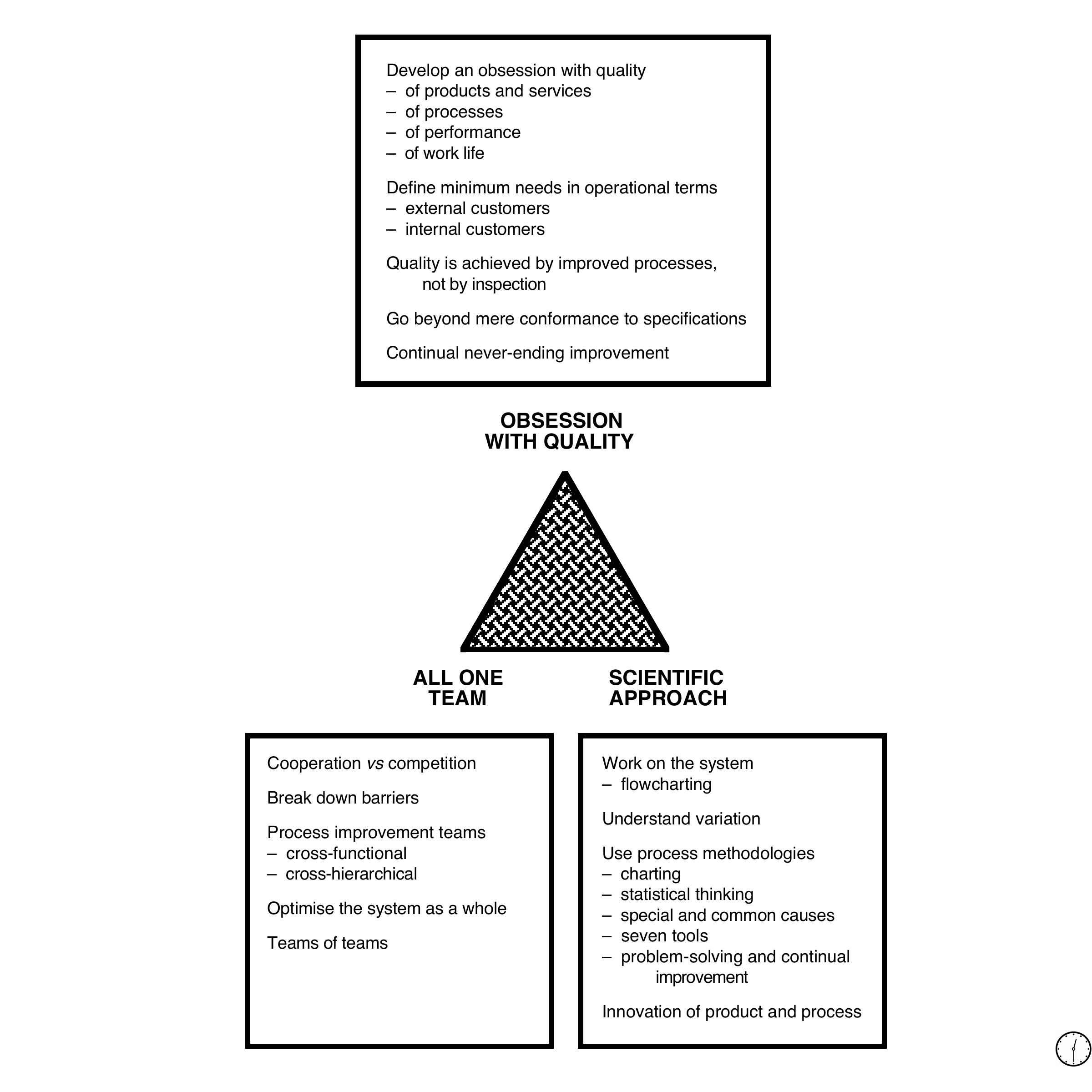
In preparation for the First Project and as promised on page 2, in the Introduction chapter, here is a fuller version of the Triangle as used by Joiner Associates’ consultants. It includes notes of a few of the topics relevant to each of the Triangle’s three foundations. Take a careful look through it: you will probably find it helpful to refer repeatedly to such an expanded version of the Triangle as you work through the forthcoming project.
Describe this diagram
The Joiner Triangle (Obsession With Quality at top, All One Team bottom-left, Scientific Approach bottom-right) with each corner now annotated by an adjacent box listing the topics that fall under that heading. Obsession With Quality lists: develop an obsession with quality (of products, processes, performance, work life); define minimum needs in operational terms (external and internal customers); quality is achieved by improved processes not by inspection; go beyond mere conformance to specifications; continual never-ending improvement. All One Team lists: cooperation vs competition; break down barriers; process improvement teams (cross-functional, cross-hierarchical); optimise the system as a whole; teams of teams. Scientific Approach lists: work on the system (flowcharting); understand variation; use process methodologies (charting, statistical thinking, special and common causes, seven tools, problem-solving and continual improvement); innovation of product and process. The diagram thus turns the three-word triangle into a working checklist for the First Project.
However, before we move on to the project, I need to consider further the Scientific Approach part of the Triangle. There are several reasons.
First, you will have already read on DemDim page 35 that “Topics which can be included under this general heading [Scientific Approach] take up a considerable proportion of this book”. That doesn’t really tie in with the mixture of topics chosen by Brian in his expanded version of the Joiner Triangle that we have just seen on the previous page. Of course, everything there is useful but, in its context relevant here as representing foundations of Dr Deming’s theory of management, some other choices could have been preferable. For example, I would have added two very important topics: Operational Definitions and the Deming Cycle. (However, I shall not include these in the box below since we won’t be studying them here until Day 11.)
Second, you will observe quite a large emphasis on tools in Brian’s choice of topics, well beyond the control chart: the seven tools, flowcharting, problem-solving. Recall that, in his four-day seminars, Dr Deming didn’t even discuss any technical details of how to construct the most important tool of all, the control chart (see Day 1 pages 7–8): so such an emphasis would be out of place here (as you know, anything “beyond the basics” is instead optional/extra-curricular). Again, this isn’t to say that the tools mentioned in the Triangle on page 11, in the Joiner Triangle chapter are not useful: indeed they are, but they can be useful whatever approach to improving quality is being adopted, whether or not it has any connection with what Deming taught.
I recall two occasions in four-day seminars when the topic of “quality tools” was raised. On one occasion Deming suggested that, regarding tools (other than the control chart) “you can learn all you need to know in an hour”. On the other occasion, a delegate was unwise enough to enquire what part one of the then-current “flavours of the month”—QFD (Quality Function Deployment)—had to play in the Deming philosophy. That prompted probably the sharpest retort I ever heard from Dr Deming at any of his seminars: “For Hell’s sakes, let’s get down to business”.
However, as you have seen, Brian did also include “statistical thinking” and “special and common causes” in his selection of topics, and so presumably “charting” definitely included the control chart! It seems wise for the current purposes to restrict our attention for most of the project which follows to understanding variation in the sense introduced by both Drs Shewhart and Deming via our opening day and about which we have now learned plenty during Days 2 and 3. This will also be ideal preparation for the Second Project on Days 10 and 11 which involves the System of Profound Knowledge (briefly introduced on Day 1 page 37) since “Understanding Variation” is one of the latter’s four component parts.
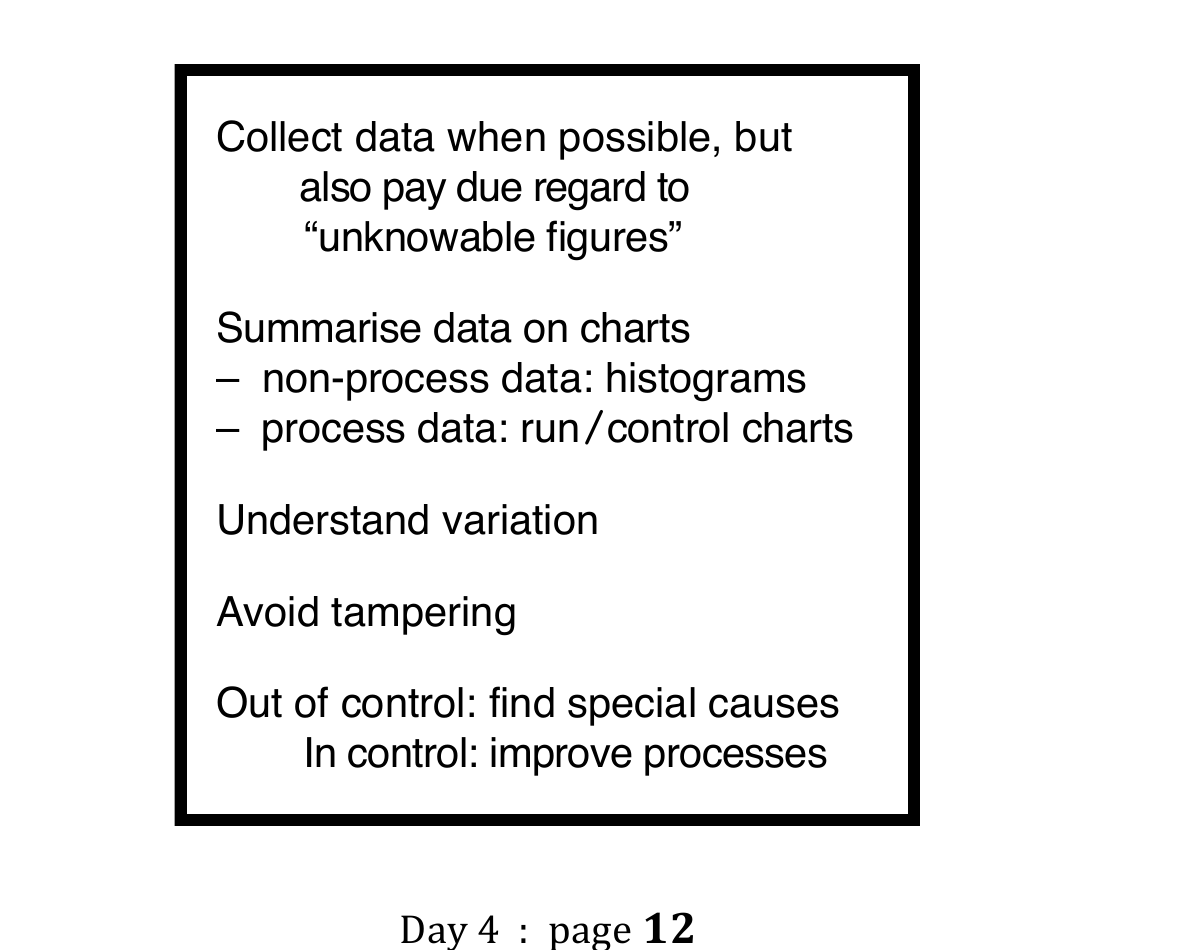
In the spirit of the expanded Joiner Triangle (but bearing in mind the above reference to Day 11), I therefore offer the following as an alternative list of topics for our current interpretation of the “Scientific Approach”:
Describe this diagram
A single bordered box listing Neave’s revised topics for the Scientific Approach corner of the Joiner Triangle. The five entries: collect data when possible, but also pay due regard to “unknowable figures”; summarise data on charts (non-process data: histograms; process data: run/control charts); understand variation; avoid tampering; out of control: find special causes / in control: improve processes. Compared with Joiner Associates’ original list, Neave’s version drops the heavy emphasis on individual tools and instead highlights the judgements a manager has to make — what to measure, how to display it, when to act, and when to leave alone.
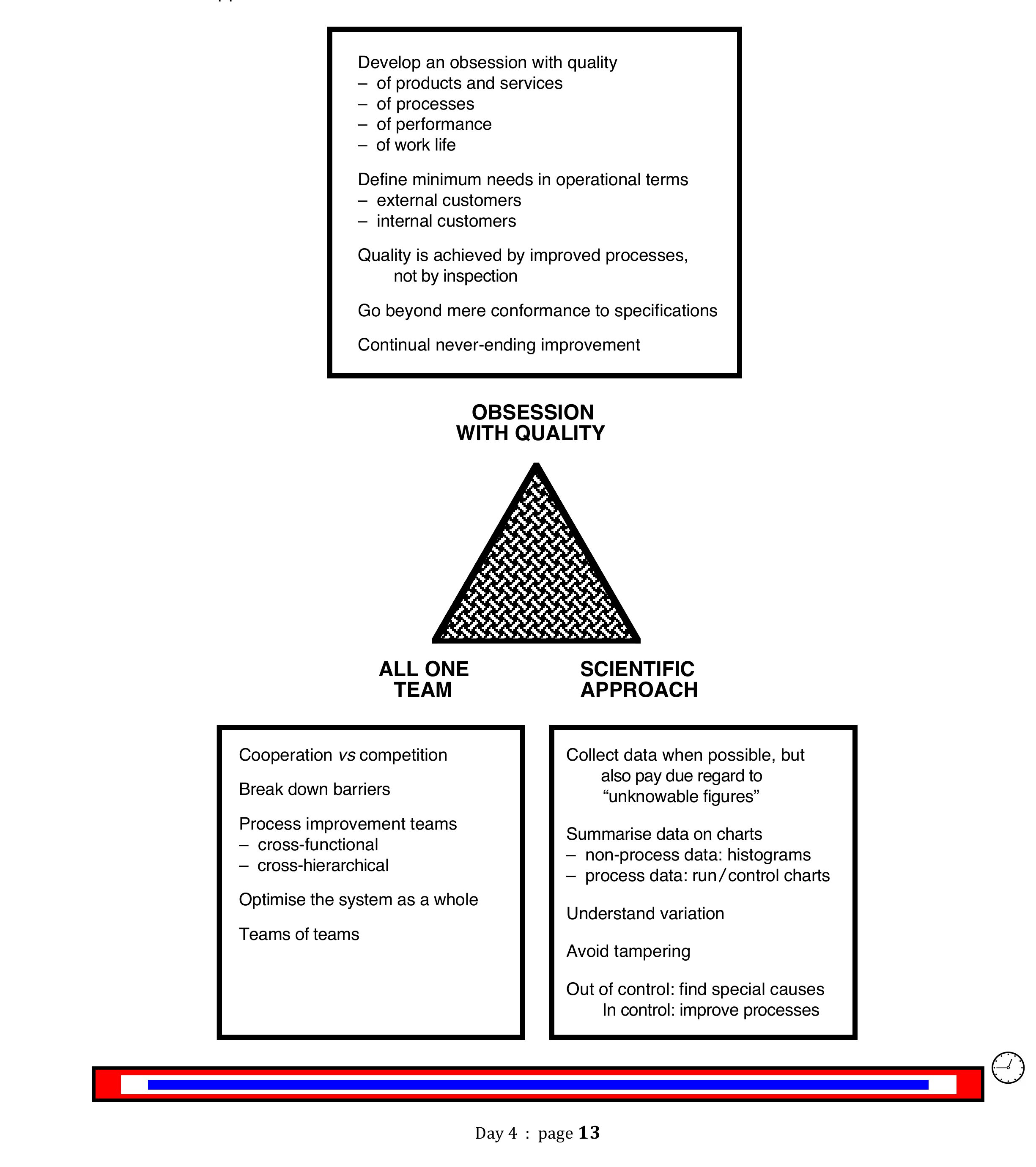
So here for your convenience is the expanded Joiner Triangle again but now with my modified version of the Scientific Approach content:
Describe this diagram
The full Expanded Joiner Triangle as Neave uses it in the rest of the course: same three corners (Obsession With Quality, All One Team, Scientific Approach) and same boxes for the first two corners as in the Joiner Associates version, but with the Scientific Approach box now replaced by Neave’s revised list (collect data but also respect unknowable figures; summarise data on charts; understand variation; avoid tampering; act differently when in vs out of control). This is the version learners should keep beside them while working through the First Project.
ACTIVITY 4–a
This Activity is in three parts. All three parts are likely to involve some deep thought—but I’m giving you plenty of time! In each of the three cases, if you have not made much progress after, say, five minutes or so then take a look at my brief suggestions on Appendix page 22 to help get you started.
“Ranking doesn’t do any good. Of two people, one would be worse and one would be better. I don’t know what we’ll do about it! The question is: Is one outside a control limit, or does the difference mean nothing?”
Expand on this statement, particularly with reference to the paragraph at the top of the previous page. Your thoughts and answers in (1) are also likely to be relevant.